How to Get Property Manager Work as a Handyman
Direct answer: Make a list of the property management companies in your town, build a printed vendor package for each one (W-9, insurance certificate, licenses, services list and pricing page), then visit 12 offices in person in one day without calling ahead. Leave the package at every office. Then treat every job they send like an emergency until you are their main handyman.
This is Ray Duke's own method, in his words where it matters.
- 12 property management offices to visit in one day
- 9 a.m. start time, no calling ahead
- 30 min per office: about 10 driving, 20 inside
- W-9 they need it before they send you any work
Why property managers
Rentals always need repairs, and the manager has to get them done with the owner's money, not their own. Once a few managers trust you, the work keeps coming.
And then you've also got my personal favorite, which is what my entire business is built around, which is property management companies. They have an endless supply of work. The jobs have to get done. They're not optional jobs. When a toilet stops running, a property manager is required by law to get that toilet fixed.
... the number one reason for that, in my opinion, is because it's not their money they're spending. ... They're really busy and they need somebody to just take maintenance off their plate.
- Fair price window: They know what a job should cost. Stay inside that window and you just invoice. No haggling.
- Vet once, not forever: Homeowners get vetted one at a time, forever. Vet a handful of managers once.
Step 1: Build your list
Ray starts with a spreadsheet (his first Tucson list had about 65 companies) to plan visits and track who he has contacted.
You don't want to contact them all at once, because then you'll get too many clients and you're not going to be able to keep up with them. So I start out with like a dozen, hoping to get one or two out of those dozen.
- Make the spreadsheet: Business name, address, contact names, emails and main phone line. Fill it from a Google search first.
- Search Zillow rentals: Filter Zillow to rentals only, single-family homes, 3 bed and 2 bath, and set a minimum rent that cuts out the cheapest, oldest rentals. Each listing shows who manages it.
- Tally who manages the most: Write each company down and add a tick mark every time you see it again. A handful of companies will turn out to manage most of the good rentals.
- Read their Google reviews: Lots of bad reviews about the managers and the maintenance usually means a cheap company with cheap owners.
- Check their websites: Look for any mention of an in-house maintenance crew. Put the companies without one at the top: they sub out all their work.
- Pick your first dozen: If you are new, start with the mid-range companies full of newer, standard subdivision homes. Save the luxury-home companies for later.
Step 2: Build 12 vendor packages
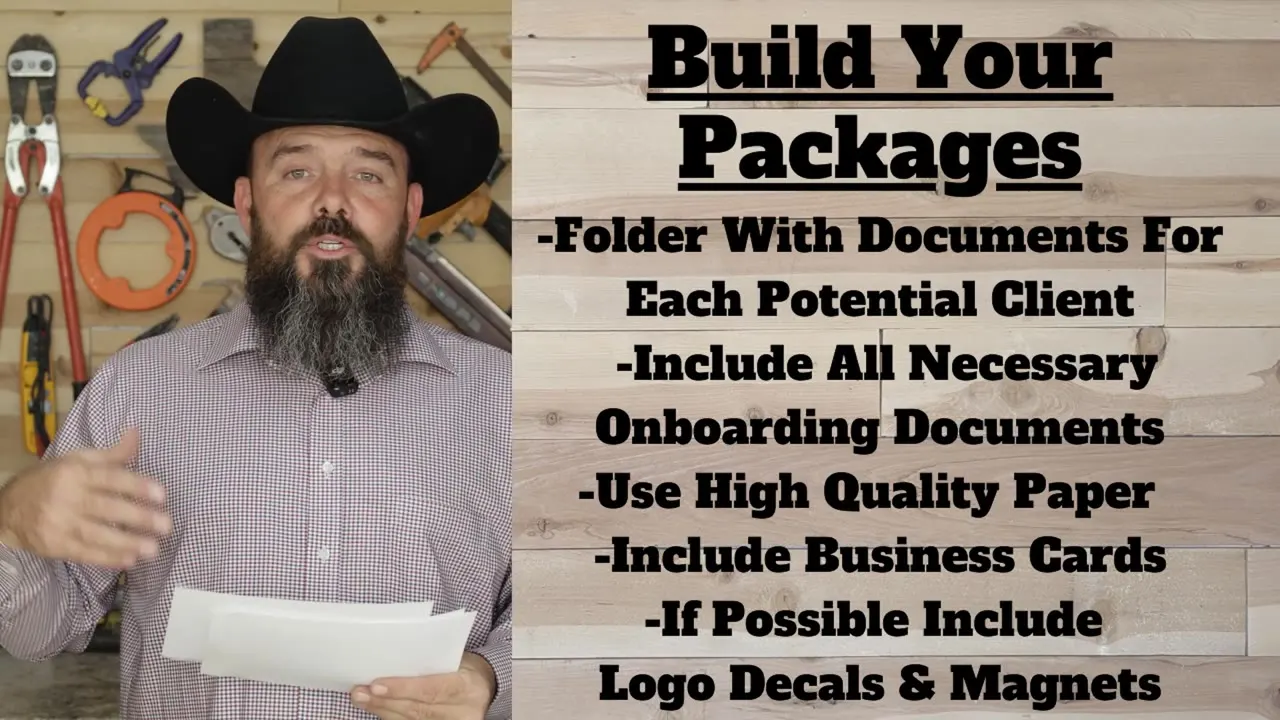
Your package is a folder with everything a property manager needs to put you on their vendor list today, or six months from now. Ray's free template is in the business documents linked at the bottom of his YouTube video descriptions. He asks you not to copy it word for word: if hundreds of handymen hand in the same letter, property managers notice. Write your own; ChatGPT can help polish it.
Use nice folders or small binders with a logo cover page and decent paper. A logo decal on a plain folder works.
- Extra step if you really want a company: have your insurance list that property management company as additionally insured before you show up. It tells them you are serious.
You also want to include in this package your business licenses, insurances and bonding, contractor's license, a completed W-9. They need a W-9 before they send you any work.
But I do want you to remember though, you're not relying on your package to sell your company. ... You're going to sell them on you ...
Checklist
- Introduction letter (half a page is fine)
- Services list: err on the side of as many as possible
- Pricing page: trip fee jobs, punch lists, move-outs, estimates
- Completed W-9
- Certificate of insurance (COI); $1 million liability is acceptable to most places
- State and city business licenses
- Articles of organization, if you are an LLC
- Workers' comp insurance, or a signed workers' comp waiver if you have no employees
- Bonding paperwork, if you are bonded
- Other licenses and certifications
- Testimonials, if you have them
- Business cards and a fridge magnet
- Optional: direct deposit form, QR code to your request form
Step 3: Hit 12 offices in one day
Don't call ahead. If they don't need a handyman today, they will say no on the phone and you lose the chance to meet them in person. Walk in as a business offering a service, not someone asking a favor. Ray says at least 1 office out of 12 is always short a handyman.
Hey, my name's Ray Duke with the Bulletproof Handyman. We serve as property managers exclusively. We offer handyman services for the entire home and I'd love the opportunity to just sit down with you for like five minutes. I don't want an answer today. I just want to show you what we do, show you what our pricing is so that you've met me. And then if you need me today, I'm available today. And if you don't need me today, I want you to just know that you've got everything you need in this beautiful package that I brought you. Anytime you want to onboard me, I got my W-9 in there. I got my insurance COI in there.
Most of y'all have tried. You've aimed for 12 and you've made it to like eight or 10. And almost every single one of you has gotten at least one client on day one.
- Pick the day: A normal weekday in the middle of the week, like a Wednesday.
- Map the route: Put the 12 addresses on a map and zigzag across town; drive time between offices should be 5 to 10 minutes. Ray uses Jobber's route optimization (Settings, Route optimization). Check that your plan includes it.
- The day before: Haircut, beard trimmed, a clean long-sleeve button-up or your logo shirt. No shorts, sandals or dirty clothes. Wash the truck and clean it out inside, and organize your tools.
- That morning: Buy gifts for the offices: fruit or veggie platters, cookies or donuts. Ray's math: 12 boxes of cookies at about $10 each is $120.
- Start at 9 a.m.: Not before 8, and 9 is better. Plan 30 minutes per office: 10 driving, 20 inside. Twelve offices runs about 9 a.m. to 3 p.m.
- Walk in looking like a contractor: Tape measure on your hip, an aluminum contractor's clipboard with a package inside. Smile, look them in the eye, shake their hand.
- Leave the package: Make sure the package stays with them when you leave. If the office is empty (some work from home), drop it through the mail slot or drop box.
What they will ask you, and how to answer
Interested managers ask, 'What's your trip fee and hourly rate?' Know your answer, and make it match your pricing page.
Ray's $125 trip fee covers most one-off jobs, and he gives no hourly rate. Dropping your price to land a company lands the budget ones.
- Ask them how often they pay.
- Most expect you to buy materials and get paid back on the invoice. Short on cash? Ask about a Home Depot Pro account, or deposits on bigger jobs.
I just say, hey, I don't have a set hourly rate. However, what I can do for you if you want is you can either send me a limit to the job, like a maintenance limit, and I just won't go over that limit without calling, or if you want to know for each job, then I can just let you know if it's going to be over 125 ...
If you're short on work, the trick isn't to offer a low price to get a property manager. The trick is to talk to twice as many property managers, three times ... the trick is to get more clients, not to lower your ... price.
What property managers expect from a vendor
Ray says what they value is not price. Given fair pricing, they want a real business that shows up and does what it says.
You need to be the vendor that they have, that when you say you're going to do something, you always do it. ... after a year of working with a property manager, they should not be able to look back one time in the last year and remember one circumstance where you told them what you were going to do and then didn't do that.
- A legit business: License, taxes paid, insurance and real experience. An LLC helps but isn't required.
- Reliability: Ray ranks it number one. When you say you will do something, you always do it.
- Fast response: Call the tenant fast, schedule soon, show up on time, keep everyone informed.
- Stay inside the work order: Do only what the work order says. If the tenant asks for more, they report it to the manager.
- Before and after photos: Ray's largest client won't pay without them. Itemize multi-item jobs.
- Fair pricing: First two to three months, stay near the bottom of the fair window. Then raise slowly and watch for pushback.
- Stand behind your work: Most managers want a one-year warranty: if it's your fault, you fix it free.
- Tenants at ease: Tenants should be comfortable with you. Never work in an occupied home without an adult present.
The vendor agreement
Bigger companies will ask you to sign a vendor agreement. Ray read his largest client's agreement on camera; terms like these are normal. Read yours before signing.
- Proof of insurance before any work is assigned, every year.
- A tax ID: you're an independent contractor.
- Contact the resident within 24 hours of a work order, immediately for emergencies.
- Before and after photos to get paid, invoices within 10 days, net 30 payment, and use of their software (his client uses Property Meld).
After the office day: follow up and lock it in
If it's not day one, be patient, guys. They've got your info. Their handyman is going to mess up eventually. They all do. And they're going to be giving you a call.
And then remember, the first time they call you and the second, third, and fourth, every job they send you is an emergency. Until you have locked yourself in as their main handyman, every single job they send you, treat it like an emergency.
- Log every contact: Note who you met at each office in your spreadsheet or CRM.
- Be patient: They have your package. Their current handyman will slip.
- No clients yet? Hit 12 more: And 12 more after that, until you land them.
- Treat the first jobs as emergencies: Fast and thorough, every time.
- Say yes: If you can figure it out, take it. Every 'no' sends them to your competitor.
- Get tenants talking: When a tenant is happy, ask them to call the property manager and say so.
- Don't depend on one: Build up a handful so losing one never sinks you.
Step-by-Step
- Build your list — Find property management companies on Google and Zillow rentals, check their reviews, favor ones with no in-house maintenance crew, and pick your first 12.
- Build 12 packages — Introduction letter, services list, pricing page, W-9, certificate of insurance, licenses and workers' comp or waiver, in a nice folder.
- Get ready the day before — Haircut, clean shirt, clean truck, route mapped.
- Visit 12 offices in one day — Start at 9 a.m., no calling ahead, bring a food gift and leave a package at every office.
- Answer price questions with confidence — Know your trip fee and what it covers. Offer a maintenance limit instead of dropping your price.
- Follow up and lock it in — Hit 12 more if needed, and treat every early job as an emergency.
Frequently Asked Questions
Should I call property managers before I visit?
Ray says no. If they don't need a handyman that day, they'll say no on the phone and you lose the chance to meet them in person.
What if they ask for my hourly rate?
Know your answer before you go in. Ray doesn't give one: he quotes his trip fee, offers to stay under a maintenance limit or call first, and writes estimates for bigger jobs.
How many property managers should I work with?
Start with a dozen visits hoping to land one or two, and build up to a handful so you're never tied to just one company.