How to Plan to Sell or Hand Off Your Handyman Business
Direct answer: A handyman business can only be sold or handed off if it works without you. That means it's its own legal entity, its prices and processes are written down, its work comes from many clients, and someone else can already run jobs. Each of these takes years to build.
Ray Duke hasn't sold his business. His plan is to hand it to his kids, and he's been building toward that. Below is how he's doing it, in his words, plus the official steps from the U.S. Small Business Administration if you sell to an outside buyer.
- 3x more valuable: Ray's W-2 son vs. any subcontractor
- 12% of income: the retirement savings Ray budgets for
- 3 ways SBA lists to value a business
Most handyman businesses can't be sold
If the business is just you and your truck, there's nothing for a buyer to buy. When you stop, it stops. Some owners build trade companies on purpose to sell them, and buyers are out there.
... there's nothing wrong with if you sold your handyman business at all, then you're doing pretty well because most people never build a handyman business that you can sell.
... companies like BlackRock, they're going around purchasing plumbing and HVAC and handyman businesses as a routine thing that they do. ... They're building them for the purpose of selling them. They're designing them from the ground up to be sellable companies.
Make the business its own thing
A sole proprietorship is you. An LLC is a separate entity that can have partners, be sold, or be left to your family. The Master Class lesson on LLC vs. sole proprietor covers the setup.
... if you want to bring on a partner or if you want to sell the business, if you want to move around ownership of the business, you can't do that if the business is you. You can only do that if the business is its own separate entity.
If the business is you and you die, the business doesn't exist anymore. If the business is an LLC and you die, the business still exists. It can be left to your spouse, to your children. It can still be run.
Build it to run without your body
Ray wrote this to his best client while explaining why he was moving to uniform pricing. If everything lives in your head and your back, the business can't outlast either one.
... if my back goes out for a month ... my entire business fails unless I turn this into a viable business that can operate without me that requires standardization processes procedures etc it's a long road ahead but it's a road I have to be on for the security of my family
Inventory is a system. The system saves you the time. ... the very first thing you need to be doing is figuring out how to put your wisdom into systems that are going to save you time later ...
- Uniform pricing: One price list for your common jobs, built as line items in your software, so anyone can quote and invoice the same way. Ray builds his in Jobber; the free Rate Book helps you start one.
- Timed and documented jobs: Ray timed himself and kept spreadsheets for about a year so the system, not his memory, holds the details of every job.
- Inventory: Parts you use often stay stocked in the van, so jobs don't depend on one person knowing what to grab.
- Set policies: Your rules on estimates, trip fees and who must be home during a job, enforced the same way every time, so they don't depend on you being there to argue them.
Don't hang the business on one client
A business that dies when one client leaves isn't worth much to anyone, including you. Ray learned this when his only client dropped him in his first year. Now his work comes from two large property management companies, each with several managers, plus a handful of smaller clients, most of them for four years or more.
- Spread your work across several companies and, inside each company, several managers.
- Keep a few smaller clients who can send work in a pinch.
- Keep replacing your worst client with a new one, so the clients you keep are long-term and good.
... whatever you do do not put yourself in the position where you have one client who's your entire business or for that matter two clients who are your entire business
Train someone who can step in
Someone besides you has to be able to run jobs and make calls. Ray trained his son by sending him to jobs, pointing him to how-to videos and giving him pointers first. The goal was a son who could keep going if Ray was gone.
... my priority with him was to teach him how to teach himself. I wanted to make sure that he knew that if something happened to me, that he wasn't just leaning on me to train him ... He should have to learn how to get clients and how to invoice jobs if I die, but he shouldn't have to learn how to learn if I die.
... my son at $30 an hour was more valuable, was three times, minimum three times more valuable to my business than any subcontractor at any price that I've ever had ... And it's not their business that they're working for. So they don't care about your business as much as their business.
I'm still running it, I guess. I'm just not the one with the hammer in my hands now.
- Send them to real jobs: Point them to a video of the task first and give a few pointers before they go.
- Teach them to teach themselves: The skill that matters most is figuring things out without you.
- Let them make the calls: Ray's son started handling situations himself when he couldn't reach Ray.
- Step back from the tools: Ray still runs his business, but someone else does the hands-on work.
Handing it to your kids
This is Ray's own exit plan. He's said since his early videos that the business will go to his kids, and he brings them into it young so they know it inside and out.
- Pay them at least minimum wage, and a fair wage for the work they actually do (Ray's rule from the same video).
- Keep them off ladders, saws, heavy equipment and hazardous chemicals. Check what your state calls hazardous work for minors.
- Check federal and state limits on the hours kids can work during the school year.
- Tax rules (IRS, read November 21, 2026): in a sole proprietorship or a partnership where each partner is a parent, pay to your child under 18 isn't subject to Social Security and Medicare taxes, and pay to a child under 21 isn't subject to FUTA. If the business is a corporation, or a partnership with a non-parent partner, those taxes apply at any age. Income tax withholding rules apply regardless of age. See the IRS Family Help page and ask your CPA.
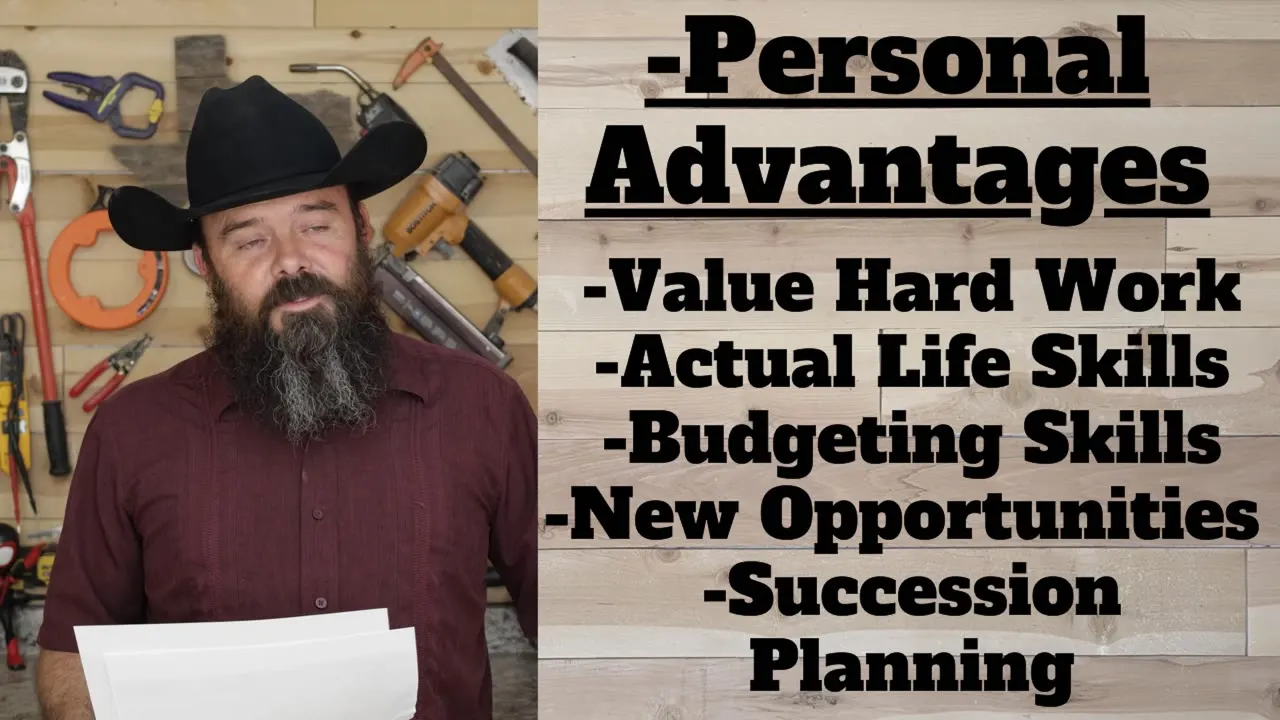
We all have to think about succession. There's going to come a day when I don't want to run this business anymore and I do want to pass it down to my children. So the earlier I get them started, the more ingrained this business is and the more intimately they understand this business inside and out, the sooner they can step into my shoes and take over the business for themselves and the sooner I get to retire.
Pay your own retirement now
Ray puts retirement savings in his overhead from the start, the same as insurance or fuel, so every job pays toward it. The Hourly Rate Calculator has a line for it.
... the national average happens to be about 12% of income would go into a retirement account ... I'm budgeting $1,000 per month to go into our retirement
If you sell to an outside buyer: SBA's steps
Ray hasn't sold a business, so this part is the official process from the U.S. Small Business Administration, written plainly (read November 21, 2026). See SBA's close or sell your business page.
- Get a valuation first: Value everything before you market the business, including things you can't touch, like your brand and your customer information.
- Pick a valuation method: SBA lists three: income (projected revenue, adjusted for risk), market (compared with similar businesses that recently sold) and assets (total assets minus total liabilities).
- Choose how ownership transfers: An outright sale (full transfer and payment now), a gradual sale (ownership moves over time on a payment plan, often with ongoing income for you) or a lease agreement (temporary rights under a contract).
- Write a sales agreement: Have an attorney review it. It should list inventory, the parties, how the business runs before closing, the buyer's access to information and fees. Don't leave out any assets or liabilities.
- Check the taxes: Passing a family business on can trigger estate and gift tax, and transferring property can be taxable. Talk to a lawyer and a CPA.
Checklist
- My business is an LLC (or another entity), not just me.
- My common jobs have set prices in my software.
- My policies are written down.
- My work doesn't depend on one or two clients.
- Someone besides me can run a job and handle a client call.
- Retirement savings are in my overhead.
- I know which path I want: sell outright, sell over time, lease, or pass to family.
Frequently Asked Questions
Can you sell a handyman business?
Yes, but Ray says most people never build one that can be sold. A buyer needs something that runs without you: a separate entity like an LLC, set prices and processes, many clients and people who can do the work.
Should my handyman business be an LLC if I want to sell it someday?
Ray says yes. If the business is a sole proprietorship, the business is you, and you can't sell it, add a partner or leave it to your family. An LLC is its own entity that can change owners and keeps existing if you die.
How do I pass my handyman business to my kids?
Ray's plan is to bring his kids into the business early so they know it inside and out, pay them a fair wage for real work, keep them off hazardous tasks, and teach them to teach themselves. Check IRS rules for family employees and your state's child labor rules.
How is a small business valued?
SBA lists three approaches: income (projected revenue adjusted for risk), market (comparison with similar businesses that recently sold) and assets (assets minus liabilities). Get a valuation before you market the business.